Lesson 7 · Review and accuracy
Review Claude’s work before you use it
Learn how to catch mistakes, hallucinations, bad assumptions, and overconfident answers before they affect real accounting work.
Primary source
Anthropic's official article Claude is providing incorrect or misleading responses explains that Claude can sometimes produce incorrect or misleading information, often called hallucination. Anthropic also notes that Claude may falsely claim capabilities, such as sending emails or creating external documents, if a tool is not actually integrated.
The one idea
Claude can be useful and still be wrong. Treat every answer as a draft, not a final accounting decision.
Claude drafts. The human verifies. The accountant is responsible.
The 4-check review
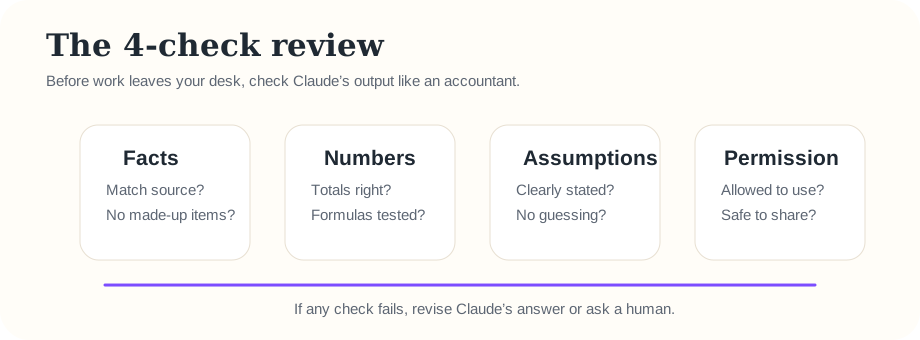
Facts
Does the answer match the source document, official website, or company policy?
Numbers
Are totals, dates, formulas, and comparisons correct when manually checked?
Assumptions
Did Claude guess anything that was not in the source information?
Permission
Is it allowed to use, send, upload, or share this information?
Practice: ask Claude to critique itself
Paste this into Claude after it drafts any accounting-related answer:
Review your answer for possible mistakes. Separate your review into: Facts to verify, Numbers to check, Assumptions you made, and Questions for a human.
This does not guarantee correctness, but it often reveals weak spots you should check.
Practice: find hidden assumptions
Paste this fake note into Claude:
Fake note: The vendor invoice is $2,400. The manager said it “looks fine.” The invoice date is May 12. The payment terms are not shown.
Then ask:
What can I safely conclude from this note, and what should I not assume?
High-risk work needs human approval
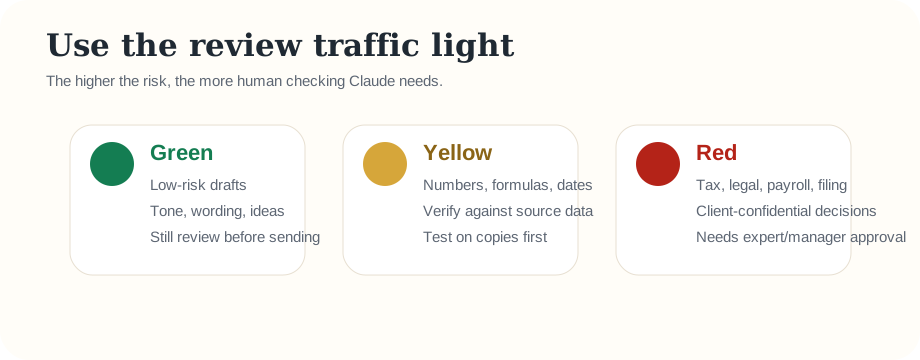
Do not rely on Claude alone for tax positions, legal interpretations, payroll decisions, filing deadlines, audit conclusions, client-sensitive decisions, or anything with financial consequences. Use Claude to prepare questions and drafts, then verify with official sources or the appropriate reviewer.
Quick check
Question: Claude produces an Excel formula for a real reconciliation workbook. What should you do first?
B = Test it on fake data or a copy first.
C = Assume Claude checked it already.
Memory practice
From memory, name the four checks.
Show answer
Facts, numbers, assumptions, permission.
Ask the teaching agent
If she is worried about an answer, ask: “Help me review this Claude output using the four checks: facts, numbers, assumptions, and permission.”